
Stairwell cleaning in a housing community – scope, schedule and contract
A clean stairwell is one of the first things residents judge the board and property manager by. We explain how often to clean a stairwell, what scope to put in the contract, how to prepare a cleaning tender for a housing community (wspólnota mieszkaniowa) and how much it costs in Warsaw and the surrounding area.
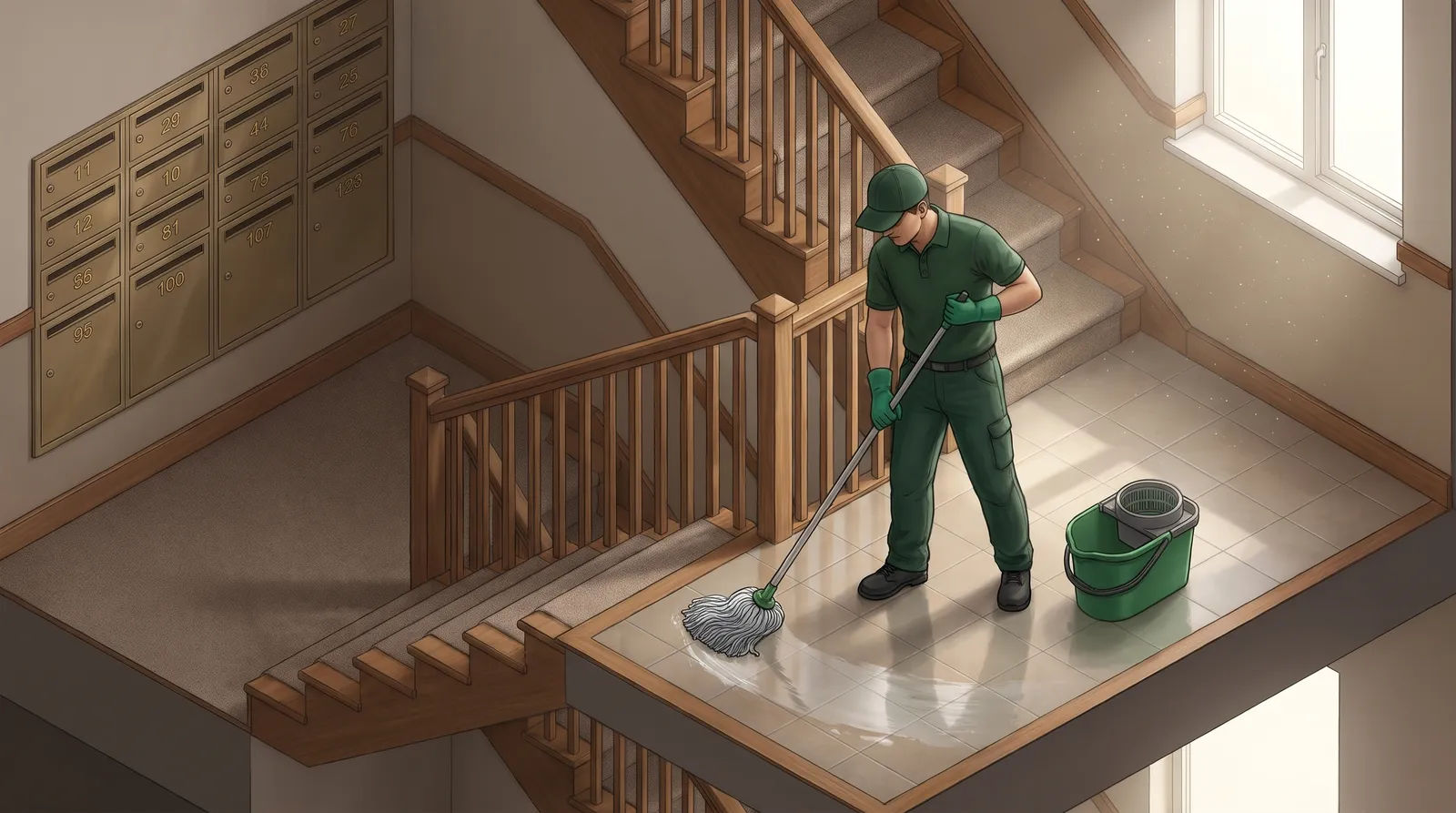
- Keeping common areas clean and tidy is a cost of managing the common property – decisions are made by the board or property manager, within the scope set by the community.
- In a typical block of flats, stairwells are cleaned 1–3 times a week, more often with heavy traffic; periodic work is planned monthly and quarterly.
- A cleaning tender for a housing community is best based on one detailed scope of work, so the offers are comparable.
- The contract should include the schedule, the scope, rules for passing on residents’ feedback and monthly billing by invoice.
- Cleaning stairwells and common areas costs from 1.70 zł/m² with us; we give an exact quote after a site visit.
Housing community duties: cleaning common areas
Stairwells, corridors, lifts, entrance lobbies, cellars, drying rooms, bike stores, the garage and the grounds around the building are common property. The Polish Act on Ownership of Premises classes spending on keeping them clean and tidy as a cost of managing the common property, covered by the flat owners through their advance payments. In practice, the community’s board or property manager is responsible for organising cleaning: choosing a contractor, the contract, quality control and responding to residents’ feedback.
A community can do the cleaning itself (e.g. by employing someone under contract), but in most buildings it is more convenient to hire a company. The property manager then gets one invoice and one contact person, and doesn’t have to arrange cover during holidays or sickness.
Good practice is to set the scope and standard of cleaning in a resolution or in the annual budget plan. Residents then know what they are paying for, and the board has a clear basis for holding the contractor to account.
How often should a stairwell be cleaned?
There is no single statutory frequency. It all depends on the size of the building, the number of flats, the level of traffic, the season and residents’ expectations. In practice, three models are common in Warsaw:
- Autumn and winter – mud, salt and grit brought in on shoes quickly damage floors. It is worth cleaning the lobby and entrance mats more often.
- Moves and flat renovations – it is a good idea to provide in the contract for extra cleaning on request.
- Lobby and lift vs floors – not everything has to be cleaned at the same frequency. The entrance lobby can be cleaned more often and the floors less often.
It is worth reviewing the frequency after the first few months. If residents don’t raise issues and the stairwells are in good condition at each visit, you can consider cleaning the floors less often while keeping the lobby on a more frequent schedule. If complaints keep coming, adding one visit a week during autumn and winter is usually enough, rather than changing the whole contract.
| Type of building | Recommended frequency | Notes |
|---|---|---|
| Tenement or small building, up to a dozen or so flats | Once a week | plus ad hoc after move-ins and renovations |
| Block of flats or building with a lift, several dozen flats | Twice a week | entrance lobby and lift more often than the floors |
| Large building, apartment block, ground-floor commercial units | 3 times a week or daily | lobby and entrance daily, floors less often |
Scope of stairwell cleaning – what should be in the contract
Most residents’ complaints are not that “nobody cleans”, but that something gets missed: cobwebs in corners, dirty glass in the doors, dusty handrails. That is why it is worth listing the scope task by task and assigning a frequency to each. Below is a template we use as a starting point.
| Frequency | Tasks |
|---|---|
| At every visit | sweeping or vacuuming stairs and landings, washing the entrance lobby, cleaning entrance mats, washing the floor and walls of the lift car, wiping handrails, door handles, lift buttons and the intercom, emptying bins |
| Weekly | washing stairs and corridors on all floors, wiping windowsills, letterboxes and noticeboards, cleaning the glass in the entrance doors |
| Monthly | washing balustrades and painted wall panels, removing cobwebs, wiping doors to technical rooms, radiators and light fittings within reach, cleaning cellars, drying rooms and bike stores |
| Quarterly or twice a year | cleaning stairwell windows, machine floor cleaning, cleaning entrance doors and glazing, cleaning the underground garage |
Cleaning schedule: how to plan it with residents in mind
A well-planned schedule is visible and predictable. Residents know when the crew comes, and the property manager has a simple way to check. A few practical rules:
- Fixed days and times – e.g. Tuesday and Friday mornings. Avoid times when most residents are leaving for or coming back from work.
- Schedule on the noticeboard – with the date of the last window cleaning and machine floor cleaning.
- Work log in the building – the crew records its visits, and the board can check them quickly.
- Cleaning from top to bottom – stairs are washed from the top floor down, so dirt isn’t carried onto cleaned sections.
- Wet floor signs – a warning sign is a simple way to prevent slips.
- Noisy and machine work – at set times agreed with the board.
A cleaning tender for a housing community – how to prepare it
Housing communities are usually not required to run a formal tender – unless a resolution or the community’s rules require it. In practice, a “cleaning tender for a housing community” means collecting several offers for the same scope and choosing the best one. For that to work, the request has to be well prepared.
The request for quotation should include:
- the address and a description of the building: number of stairwells, storeys and lifts, floor types, cellars, garage, grounds,
- the area to be cleaned, ideally split into stairwells, garage and grounds,
- the scope of work with frequencies (you can use the table above),
- expectations for extra services: window cleaning, snow clearing or gritting, grounds maintenance, removing pigeon droppings,
- required documents: company registration details, third-party liability insurance, invoicing,
- a date for bidders to view the building,
- selection criteria: price, scope, experience with similar buildings, response time to reports,
- the contract term and notice conditions.
How to compare offers without overpaying
The cheapest offer is not always the best for the community. If the contractor has allowed too little time for the building, quality drops after a few weeks and the property manager starts getting complaints. When comparing, check whether the bidder viewed the building, whether it set out the scope, whether it stated how many visits a week it plans, and who will be the board’s contact.
It is worth asking for references from other property managers. A property manager from Ursynów described working with us like this: “They look after the stairwells and the grounds around the building. Residents have stopped complaining, which speaks for itself.” A review like that says more than the price – the number of residents’ complaints is the simplest measure of cleaning quality.
You will find broader tips on choosing a contractor in our article how to choose a cleaning company – the questions there work for residential buildings too.
A stairwell cleaning contract – key clauses
A contract with a housing community should be specific and easy to read for board members, who change every few years. The most important elements:
- Subject and scope – an annex with a list of tasks and frequencies for each area.
- Schedule – days and approximate times of visits, rules for changes on public holidays.
- Fees – the monthly amount, prices for extra work (e.g. cleaning after a flat renovation, window cleaning), monthly billing by invoice.
- Supplies – who provides cleaning products and bags; as standard, the contractor does.
- Raising issues – who reports issues on behalf of the community, through which channel, and how quickly the contractor responds.
- Access – keys to technical rooms, codes, rules for keeping them safe.
- Liability and insurance – for damage caused during the work.
- Term and notice – a reasonable notice period that lets the community change contractor if quality drops.
Not just stairwells: common areas and the grounds around the building
Residents judge the building as a whole. A clean stairwell but a littered bin area, dirty paving at the entrance or a dusty garage spoil the effect. That is why many communities hire one contractor for everything: stairwells, garage, grounds and greenery. One contract, one invoice and one contact for the property manager.
Indicative prices for the services most often combined with stairwell cleaning:
| Service | Indicative price |
|---|---|
| Stairwells and common areas | from 1.70 zł/m² |
| Housing estate grounds | from 0.50 zł/m² |
| Underground garages | from 5 zł/m² |
| Machine floor cleaning | from 1.50 zł/m² |
| Window cleaning | from 12 zł/m² |
| Pressure washing block paving | from 10 zł/m² |
| Removing pigeon droppings | from 20 zł/m² |
| Grass mowing | from 1.50 zł/m² |
Quality control: how a property manager can check the cleaning
The property manager is rarely in the building when the crew visits, so checks have to be simple. A few solutions work well without creating extra work for the board – we have listed them below.
The most important thing, though, is that feedback goes to one place. When residents write to different board members, who pass it on to the contractor in different ways, chaos follows easily. One person on the community’s side and one on the company’s side is the simplest recipe for smooth cooperation.
- A monthly walk-round with a company representative – 20 minutes through the lobby, a few floors, the lift and the cellar.
- A visit log posted in a technical room or kept electronically.
- Photos after periodic work – e.g. after window cleaning or machine floor cleaning.
- One reporting channel – residents report issues to the property manager, who passes them on to the company, instead of chatting to the crew in the corridor.
Seasonal tasks in common areas
Stairwell cleaning is year-round work, but each season brings different tasks. In autumn and winter the priorities are entrance mats, cleaning salt and grit off the lobby floor and making sure the floor by the entrance isn’t slippery. Spring is the time for cleaning stairwell windows, machine floor cleaning after winter, block paving cleaning in front of the entrance and tidying the cellars. In summer it is worth scheduling work that needs longer drying times, and looking after the greenery around the building.
Listing these tasks in the contract up front, with an approximate month for each, means you don’t have to renegotiate them every season, and the community can plan them in its budget.
How much does stairwell cleaning cost for a housing community
Cleaning stairwells and common areas costs from 1.70 zł/m² with us. The final monthly amount depends on the area, the number of visits per week, the number of lifts, floor types, the condition of the building and the scope of periodic work. That is why, before quoting, we always offer a free site visit – together with a board member or the property manager we walk through the stairwells, cellars and garage.
With a new contract we offer up to 20% off the first month. Under a regular contract, a regular team that knows the building does the work, and the property manager has one contact person who calls back within 15 minutes during working hours. We bill monthly by invoice. We describe the service in detail on the stairwell cleaning page, and our offer for garages and grounds on the underground garage cleaning and outdoor area cleaning pages.
We serve housing communities and property managers in Warsaw and the surrounding area within a radius of about 20–30 km. You can check an indicative cost in the calculator, and the full price list under prices.
Do you manage a housing community or a building? Book a free site visit and get a quote for cleaning the stairwells, garage and grounds in one offer. We will call you back within 15 minutes during working hours, and with a new contract you get up to 20% off the first month.
Stairwell cleaning →Questions and answers
How often should the stairwell in a block of flats be cleaned?
Is stairwell cleaning the housing community’s responsibility?
Does a housing community have to hold a tender for cleaning?
How much does stairwell cleaning cost?
Do you also clean garages and the grounds around the building?
How does a housing community raise issues about the cleaning?
Quote in 1 minute
Choose your premises, answer a few questions and see an estimated price. No sign-up, no obligation.
- 01You answer a few questionsProperty type, floor area or rooms, frequency, date.
- 02You see an estimated priceStraight away on screen, no waiting for an email.
- 03We call back within 15 minutesWe arrange a site visit and send you a written offer.
Would you rather talk straight away? +48 881 331 880 · WhatsApp
How to choose an office cleaning company – 10 questions worth asking
A good cleaning company is one you stop thinking about after a few weeks, because the office is simply clean. Before you get there, you have…
Block paving cleaning in spring: when and how
After winter, block paving is grey from salt and grit, moss is growing in the joints and weeds are coming up along the kerbs. We explain whe…
How often should you clean office windows? A practical schedule
Dirty office windows are noticed straight away – from the street, from the meeting room and in video calls. We explain how often to clean of…
Describe your premises and we’ll work out the price
We call back within 15 minutes during working hours. Site visits and quotes for larger premises are free.